Urban parks are important public resources that promote residents’ well-being and social equity. However, does an equitable spatial distribution of parks necessarily mean that different social groups can enjoy their benefits equally?
Recently, a research team led by De Tong at Peking University Shenzhen Graduate School published a study titled “The Unevenness of Urban Park Usage: From Place-Based to Activity-Based Disparities” in Applied Geography, a leading international journal in geography. The study investigates the gap between equitable spatial access to parks and equitable actual use, as well as the factors underlying this disparity. It calls for urban planning to shift its focus from physical space to the actual needs of different population groups, emphasizing that the ultimate goal of equalizing access to basic public services should be to promote equal well-being among residents.
Research Overview
Urban parks are important public resources for promoting residents’ well-being and social equity. However, an equitable spatial distribution of parks does not necessarily mean that different social groups benefit from them equally.
Comparing park accessibility and actual usage in urban villages and commercial housing communities in Shenzhen, the study finds that:
1.Comparable park accessibility, but significantly lower usage in urban villages. Although the two types of communities have similar levels of park accessibility, residents of urban villages visit parks significantly less frequently.
2.Socioeconomic differences are a major factor behind disparities in park use. The lower visitation frequency in urban villages is primarily associated with differences in residents’ socioeconomic composition.
3.Work-related conditions also significantly affect park use. Employment stability and the spatial relationship between home and workplace are particularly important.
The study reveals the gap between equitable spatial access to parks and equitable actual use, together with the factors contributing to this disparity. It calls for people-centered, high-quality spatial development to shift its emphasis from “investment in physical assets” to “investment in people,” with the ultimate goal of equalizing residents’ well-being through the provision of basic public services.
Research Methodology | From “Availability” to “Actual Use”
The study measures spatial opportunities and actual park use using two approaches: place-based park accessibility and activity-based park usage.
For place-based accessibility, the researchers employ a Gaussian two-step floating catchment area (2SFCA) method that incorporates park size, distance, and the potential service population. This approach captures the potential opportunities residents have to access park services based on their residential locations—in other words, how much opportunity they have to use parks.
For activity-based usage, the researchers use mobile phone signaling data from China to identify residents’ visits to parks. The frequency of park visits by community residents serves as a measure of actual use—in other words, how frequently parks are actually used.
The study focuses on urban villages and commercial housing communities in Shenzhen. Using geographic nearest-neighbor matching, the researchers compare spatial opportunities and actual park use between the two types of communities under similar spatial conditions. They then apply an XGBoost-SHAP model to identify how factors such as the built environment, population structure, housing costs, and work-related commuting affect park use, including their nonlinear effects.
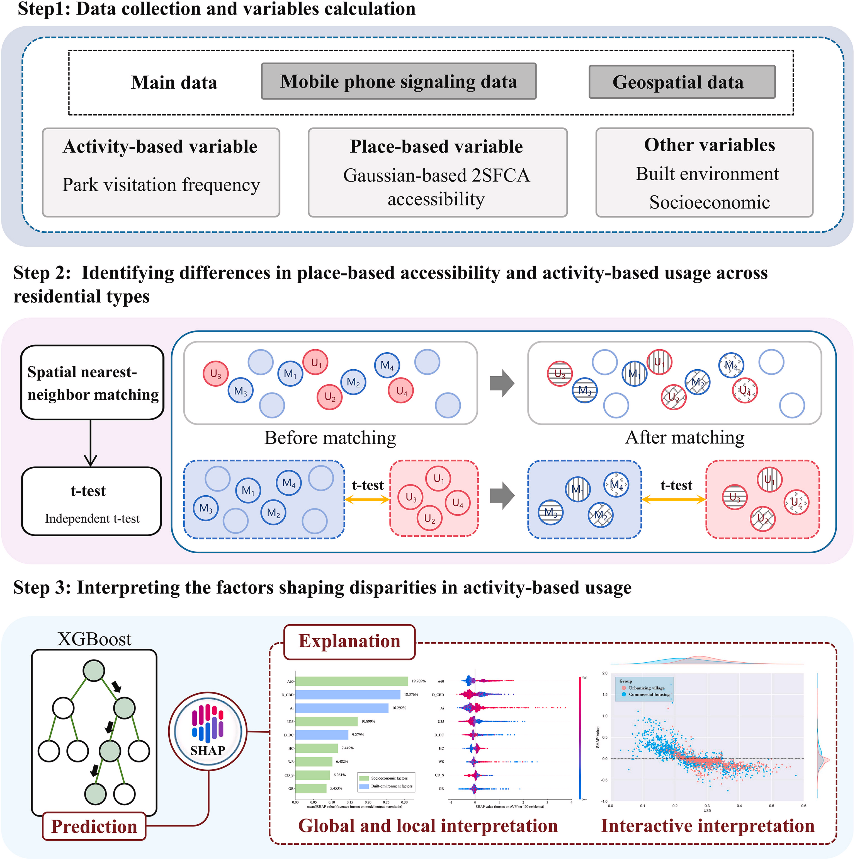
Figure 1. Analytical framework
Finding 1 | Having Parks Nearby Does Not Mean People Will Use Them
Overall, urban villages and commercial housing communities have comparable levels of park accessibility. After spatial matching, the differences between the two types of communities become even smaller. Nevertheless, residents of commercial housing communities continue to visit parks significantly more frequently than residents of urban villages.
Similar park resources do not necessarily translate into similar patterns of actual use.
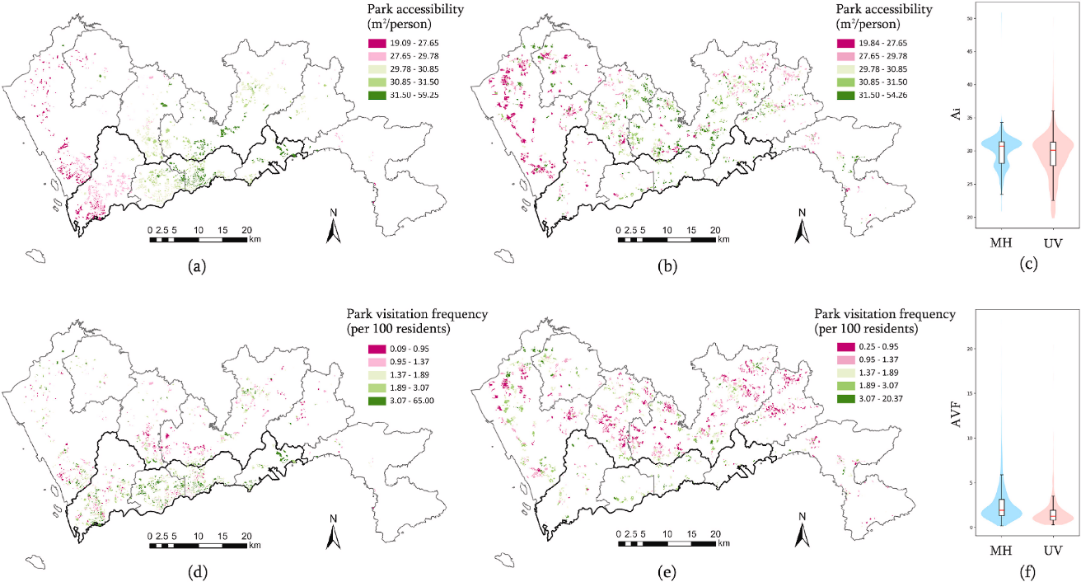
Figure 2. Differences in park accessibility (a, b) and actual park use (d, e) between urban villages and commercial housing communities
Finding 2 | Park Use Is About More Than Distance
Socioeconomic factors explain differences in park use to a greater extent than built-environment factors. Among these, population age structure and housing costs are particularly important.
Inequalities in park use are therefore not primarily determined by where parks are located, but are more closely associated with the socioeconomic circumstances of residents in different communities.
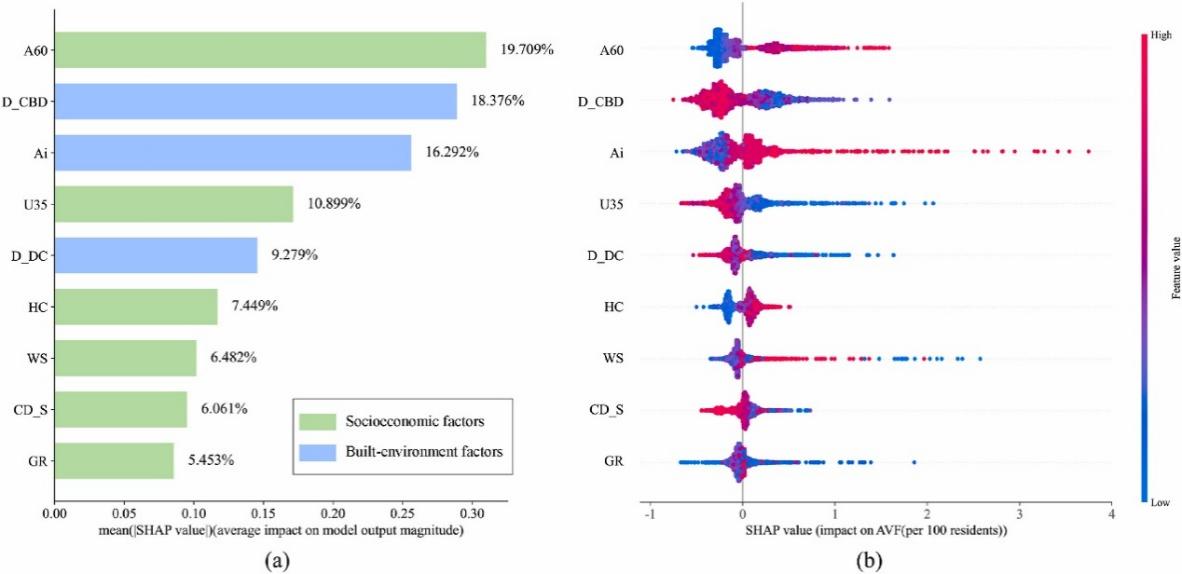
Figure 3. Ranking of the importance of built-environment and socioeconomic factors in explaining park use
Finding 3 | Park Use Is Also Shaped by Everyday Life
Workplace stability and the spatial relationship between home and work also have significant effects on park visitation.
Whether residents use parks is not simply a matter of distance. Rather, park use is embedded in the routines of everyday life, shaped by the interplay of residential location, work, and leisure.
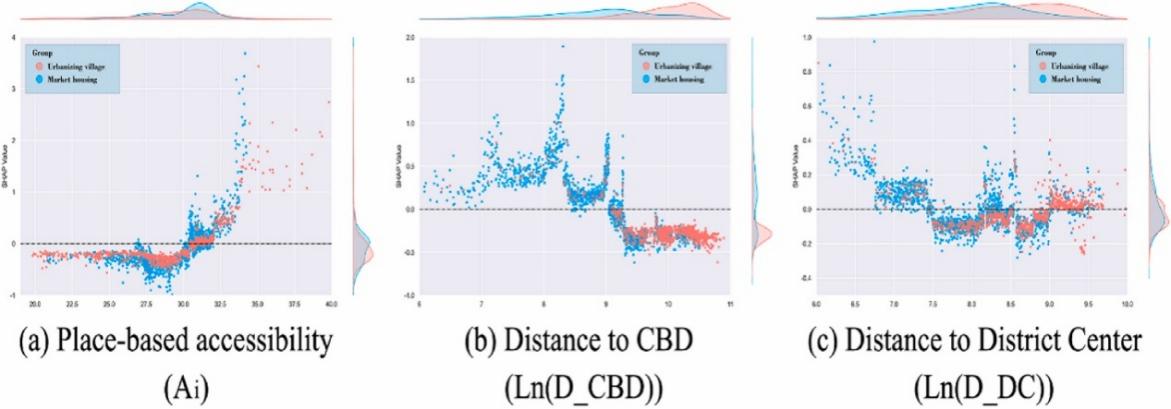
Figure 4. Nonlinear effects of built-environment factors on actual park use
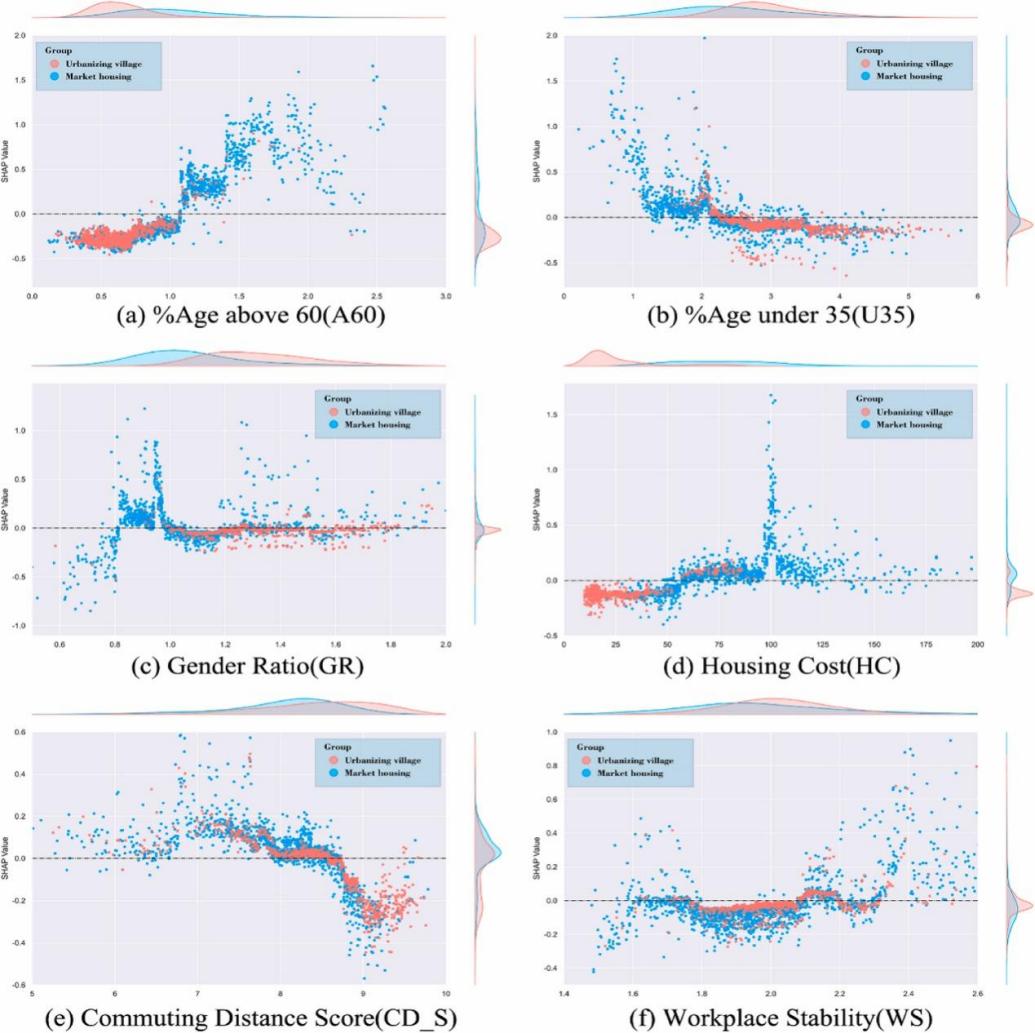
Figure 5. Nonlinear effects of socioeconomic factors on actual park use
Policy Implications
An equitable spatial distribution of parks does not necessarily translate into equal levels of actual use. This demonstrates that equalizing access to basic public services, with parks as one example, depends not only on how resources are distributed, but also on whether different social groups can turn spatial opportunities into actual use.
Accordingly, people-centered, high-quality spatial development should shift its emphasis from “investment in physical assets” to “investment in people.”
First, park equity should be assessed not only by whether parks are available, but also by whether people actually use them.
Second, reducing disparities in park use requires more than building additional parks. Greater attention must be paid to the actual needs of residents in different communities.
Third, spatial planning should move beyond planning physical spaces to understanding how people live. Meeting residents’ real needs is the essence of people-centered planning.
Publication Information
De Tong*, Meiyu Xiong, Yueer Dai, Hanting Li, and Tao Shi. (2026). “The Unevenness of Urban Park Usage: From Place-Based to Activity-Based Disparities.” Applied Geography, 196, 104151.
https://doi.org/10.1016/j.apgeog.2026.104151
Text and images: Hanting Li
Reviewed by: De Tong
