Urban agglomerations are widely regarded as a key engine for promoting coordinated regional development. Yet an important question remains unresolved: do urban agglomeration policies truly reduce regional inequality, or might they unintentionally widen disparities?
Recently, a research team led by Tong De at Peking University published a study titled “The Double-Edged Effect of Urban Agglomeration on Regional Inequality” in Annals of the American Association of Geographers (AAAG), a leading international journal in geography. Using China’s national urban agglomeration policies as a quasi-natural experiment, the study reveals the complex and dynamic effects of urban agglomeration policies on regional inequality, offering new insights for the design and optimization of regional development policies.
Authors
First and Corresponding Author:
Tong De, Research Fellow, Peking University Shenzhen Graduate School
Co-authors:
Jiang Zizhen, Master’s Student, Peking University
Yang Huiyu, Peking University alumnus
Anping Chen, Researcher, Colorado State University
Research Overview
Urban agglomeration development has become a central strategy in China’s new urbanization agenda. However, whether such policies reduce or exacerbate regional inequality remains an open debate.
Combining theoretical analysis with a quasi-natural experimental design, the study constructs a panel dataset covering 158 policy-implemented regional units and 114 non-policy regional units from 1995 to 2019, based on nationwide nighttime light data. Using econometric methods including Propensity Score Matching-Difference-in-Differences (PSM-DID), the study reaches three major conclusions:
1. A “Double-Edged” Short-Term Effect
In the early stage of policy implementation, urban agglomeration policies tend to increase inequality within cities while simultaneously reducing inequality between cities. Because these two effects offset each other, the overall impact on regional inequality is statistically insignificant.
2. An Inverted U-Shaped Temporal Trajectory
The effects of urban agglomeration policies evolve dynamically over time rather than remaining constant. The impact follows an inverted U-shaped trajectory—first intensifying inequality and later alleviating it. Intra-city inequality peaks approximately 3 years after policy implementation, while inter-city inequality reaches its turning point much earlier, at around 1 year.
3. The Dual Role of Government Intervention
Government intervention plays different roles at different stages of development. In the early phase, intervention helps curb the rise of regional inequality. However, once the policy passes the turning point of the inverted U-shaped curve, excessive intervention may hinder the market-driven convergence of regional disparities.
Theoretical Framework
To explain how urban agglomeration policies influence regional inequality, the study draws on Krugman’s core-periphery theory and Hirschman’s polarization-trickle-down theory, proposing that policy effects follow an inverted U-shaped trajectory.
The framework centers on two key mechanisms:
·Polarization Effect: In the early stage of policy implementation, central cities possess stronger advantages in efficiency, markets, and public services. As a result, capital, technology, and talent concentrate rapidly in core cities, widening disparities both between core and peripheral cities and within cities themselves.
·Diffusion Effect: As regional integration deepens and agglomeration reaches an optimal threshold, diminishing marginal returns and rising congestion costs encourage factors of production to flow outward. Technology spillovers gradually strengthen, reducing regional disparities over time.
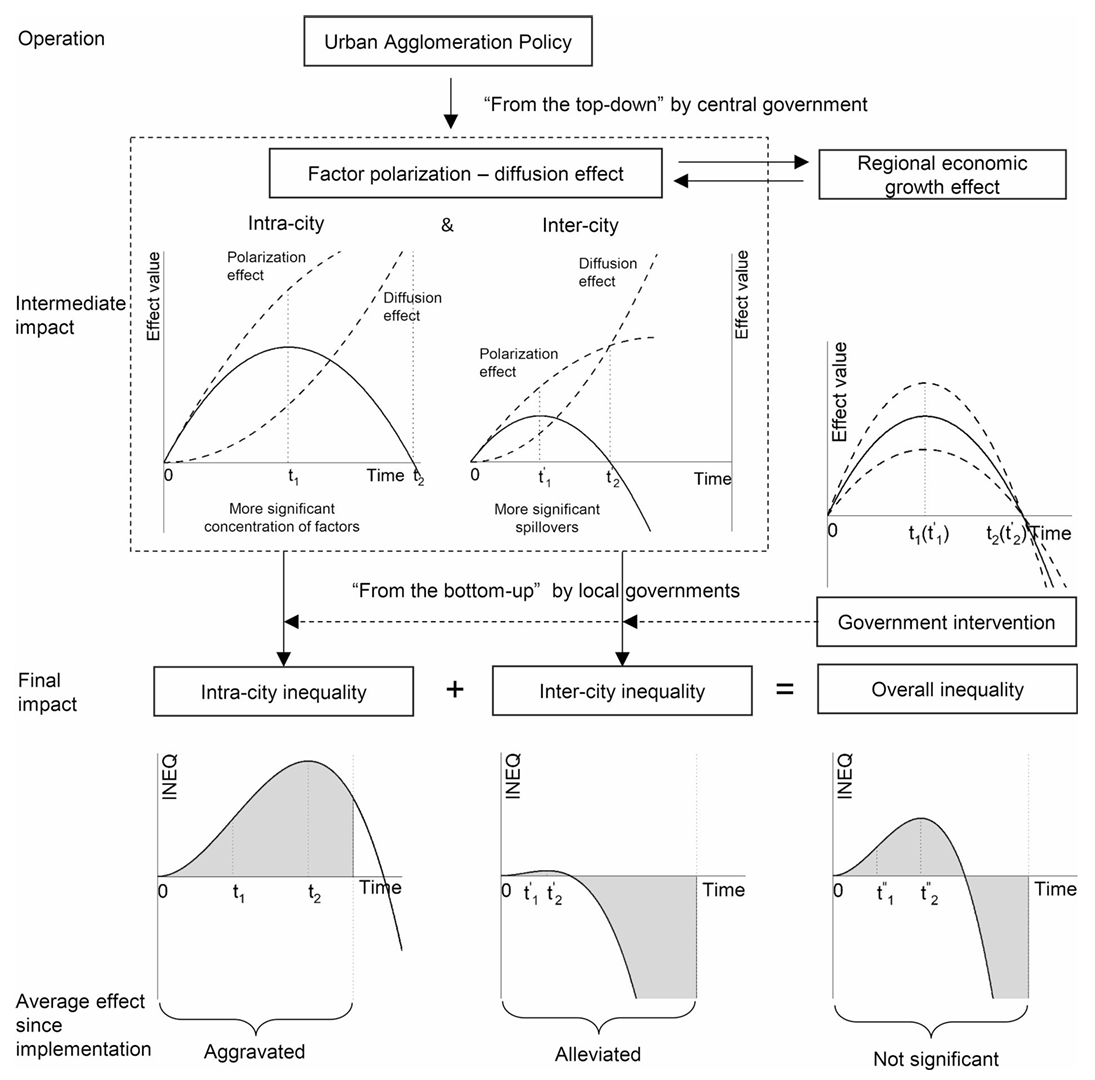
The study further incorporates local government intervention into the framework. In practice, local governments often adopt measures such as tax incentives and land subsidies in pursuit of economic performance and fiscal competition. Such interventions may distort the free flow of production factors and influence the evolution of regional inequality.
Empirical Analysis
Study Area and Data Sources
The study examines 13 officially approved national urban agglomerations in China, covering 158 prefecture-level cities with urban agglomeration policies and 114 cities without such policies, forming a total of 272 regional units.
The analysis uses DMSP-OLS and NPP-VIIRS nighttime light data from 1995 to 2019 as proxies for regional economic development. Population data are drawn from the China Urban Statistical Yearbook and local statistical yearbooks.
Core Variables and Methods
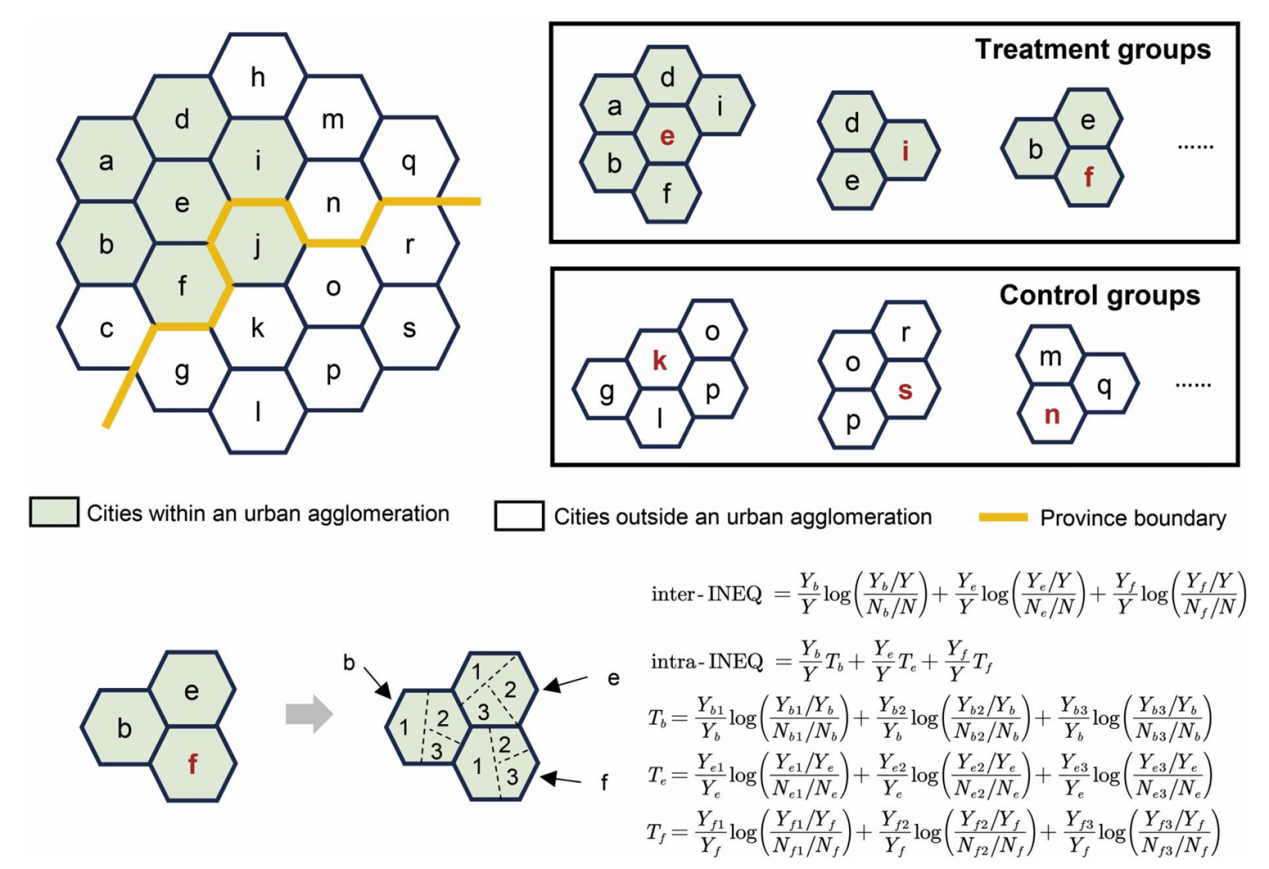
Regional inequality serves as the dependent variable. The study adopts the decomposable Theil-T Index to measure inequality, separating overall regional inequality into:
·Intra-city inequality: disparities among districts and counties within the same city;
·Inter-city inequality: disparities between different cities.
The implementation of urban agglomeration policy serves as the core independent variable. A Difference-in-Differences (DID) model compares policy and non-policy regions before and after implementation to identify the net policy effect while controlling for time trends and regional heterogeneity.
Identification Strategy
To address potential self-selection bias in policy designation, the study employs a PSM-DID approach. First, treatment units are matched with comparable control units based on propensity scores. The DID model is then estimated using the matched samples.
The researchers also construct a dynamic DID model incorporating policy exposure duration and its quadratic term to test the inverted U-shaped relationship and calculate turning points. Robustness checks—including parallel trend tests, placebo tests, and alternative matching strategies—confirm the reliability of the findings.
To examine the moderating role of government intervention, the study introduces a variable measuring intervention intensity, defined as the ratio of local fiscal expenditure to GDP.
Major Findings
The “Double-Edged” Effect of Urban Agglomeration Policies
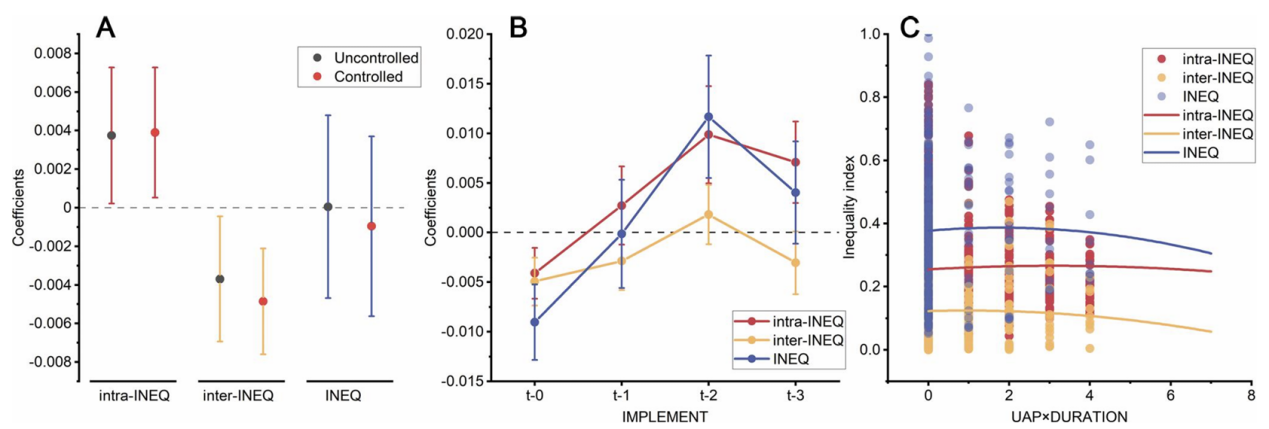
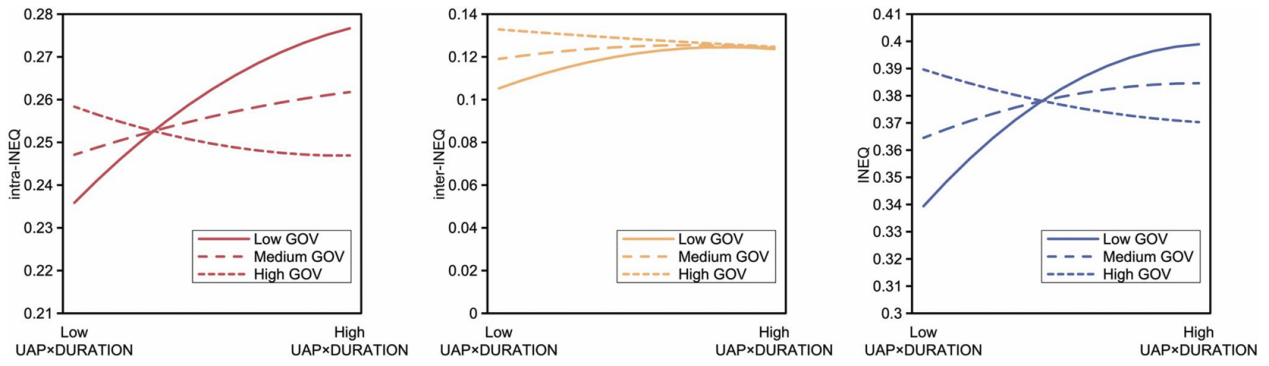
By 2019, urban agglomeration policies had significantly increased intra-city inequality while significantly reducing inter-city inequality. Because the two effects move in opposite directions, the overall change in regional inequality is statistically insignificant. The findings suggest that policies designed to reduce disparities between cities may unintentionally deepen inequalities within cities.
An Inverted U-Shaped Evolutionary Process
The effects of urban agglomeration policies are dynamic rather than linear.
Intra-city inequality continues to rise after policy implementation, peaking around 3.08 years later before gradually declining. This suggests that polarization within cities persists for a relatively long period before diffusion effects begin to emerge.
Inter-city inequality, by contrast, reaches its peak much earlier—approximately 0.94 years after implementation—before entering a sustained downward trend. This earlier turning point indicates that cross-city factor mobility and technological spillovers emerge more rapidly, allowing market forces to reduce disparities between cities more efficiently.
Time-Varying Moderating Effects of Government Intervention
The moderating effect analysis reveals the “dual nature” of government intervention.
In the early stage of policy implementation, government intervention significantly suppresses the growth of regional inequality, effectively acting as a stabilizing force during the polarization phase.
However, in later stages, excessive intervention inhibits the spontaneous convergence of regional disparities that would otherwise occur through market-driven diffusion effects. In this context, intervention may become an obstacle rather than a facilitator of balanced regional development.

Conclusions and Policy Implications
The study’s major contribution lies in proposing and validating the theoretical framework of the “double-edged effect” and the “inverted U-shaped trajectory” of urban agglomeration policies, while also highlighting the consequences of government intervention.
The findings demonstrate that urban agglomeration policies may reduce inequality between cities while simultaneously increasing inequality within cities, thereby offsetting gains at the regional level.
Based on these findings, the study proposes three policy recommendations:
1. From “Symbolic Planning” to “Contractual Governance”
Regional governance frameworks with real institutional authority should be established, including clear responsibilities, tax-sharing arrangements, and GDP allocation mechanisms, in order to protect the interests of resource-exporting regions and encourage intergovernmental cooperation.
2. Greater Attention to Intra-City Coordination
As urban agglomerations continue to develop, local government evaluation systems should place greater emphasis on intra-city coordination and rural-township development, avoiding development strategies that prioritize urban cores while neglecting peripheral areas.
3. Reducing Excessive Intervention After the Turning Point
For mature urban agglomerations that have already passed the turning point of the inverted U-shaped trajectory, unnecessary administrative intervention should be gradually reduced, allowing market mechanisms to play a larger role in regional factor allocation and facilitating the spontaneous convergence of regional disparities.
Publication Information
Tong, D.*, Jiang, Z., Yang, H., & Chen, A. (2026). The Double-Edged Effect of Urban Agglomeration on Regional Inequality. Annals of the American Association of Geographers. DOI: 10.1080/24694452.2026.2659908
