Biodiversity loss is one of the major challenges facing global sustainable development. Globalization and the rapid expansion of global supply chains are accelerating biodiversity loss, yet the long-term dynamic relationships among economic activities, trade networks, and species threats have not been systematically assessed.

Drawing on species threat records from the International Union for Conservation of Nature (IUCN) Red List, together with global economic activity and environmental data, the research team constructed a biodiversity threat database covering 185 countries across six global regions and multiple economic sectors. The team then employed an environmentally extended multi-regional input-output (EE-MRIO) model to establish a “species–sector–country” tracking framework, quantifying the equivalent number of threatened species associated with production, trade, and final consumption throughout global supply chains. Finally, structural decomposition analysis was used to identify the key drivers of changes in biodiversity threats across global supply chains and to reveal how responsibility is distributed between producing and consuming countries.
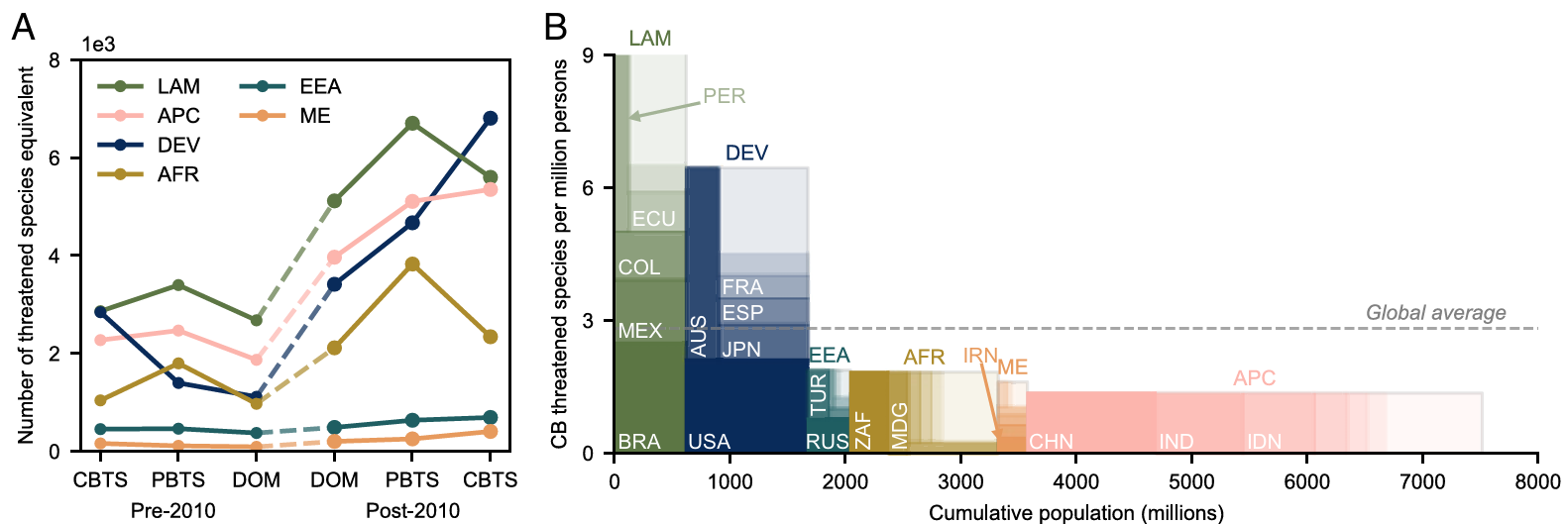
Figure 1. Changes in threatened species across six global regions from the pre-2010 period to the post-2010 period
The findings show that biodiversity impacts associated with global supply chains have continued to intensify. Changes in consumption patterns and shifts in the species-threat intensity of economic activities are the main drivers of this increase. Bilateral trade between the United States and Madagascar is associated with the highest number of threatened species among all bilateral trade flows worldwide.
The study aims to reveal how responsibility is distributed among consuming countries within global supply chains and to provide a scientific basis for establishing a fair and accountable global biodiversity governance system.
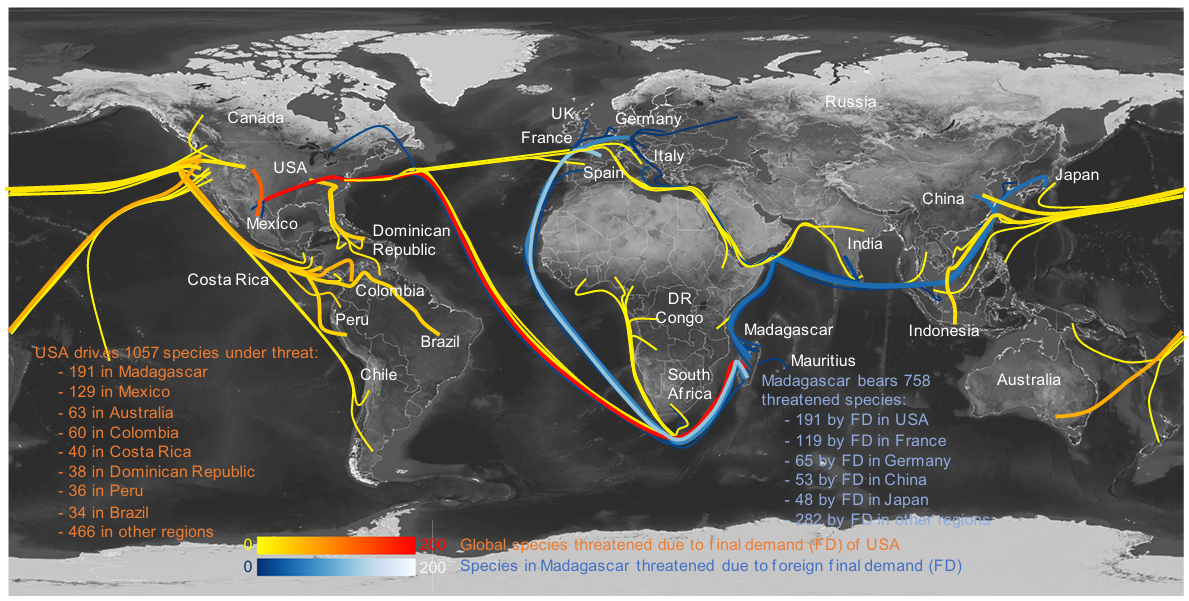
Figure 2. International flows of threatened species associated with trade between the United States and Madagascar
The paper, titled “A Three-Decade-Long Analysis Shows Rising Threatened Species and Responsibility Gaps in Global Supply Chains,” was published in the Proceedings of the National Academy of Sciences of the United States of America (PNAS) on August 31, 2026.
The first author is Ling Zhang, a doctoral student on Professor Wu Jiansheng’s team at the School of Urban Planning and Design, Peking University Shenzhen Graduate School. In 2024, Zhang was selected for the Young Scientist Summer Program (YSSP) at the International Institute for Applied Systems Analysis (IIASA). Supported by an international exchange and collaboration project of the National Natural Science Foundation of China (NSFC), Zhang conducted research on biodiversity footprints in Austria under the joint supervision of IIASA mentors Professor Brian Fath and Professor Ali Kharrazi, together with her domestic supervisor.
IIASA researcher Quanliang Ye is a co-first author. Quanliang Ye, Professor Wu Jiansheng, and Professor Brian Fath are co-corresponding authors. Other collaborators include Professor Qingxu Huang of Beijing Normal University and Professor Ali Kharrazi of Tianjin University.
The research was supported by the National Natural Science Foundation of China (Grant Nos. 42130505 and 42411540178, among other funding sources).
Original article: https://www.pnas.org/doi/10.1073/pnas.2604868123
Text and images: Ling Zhang
Reviewed by: Wu Jiansheng
